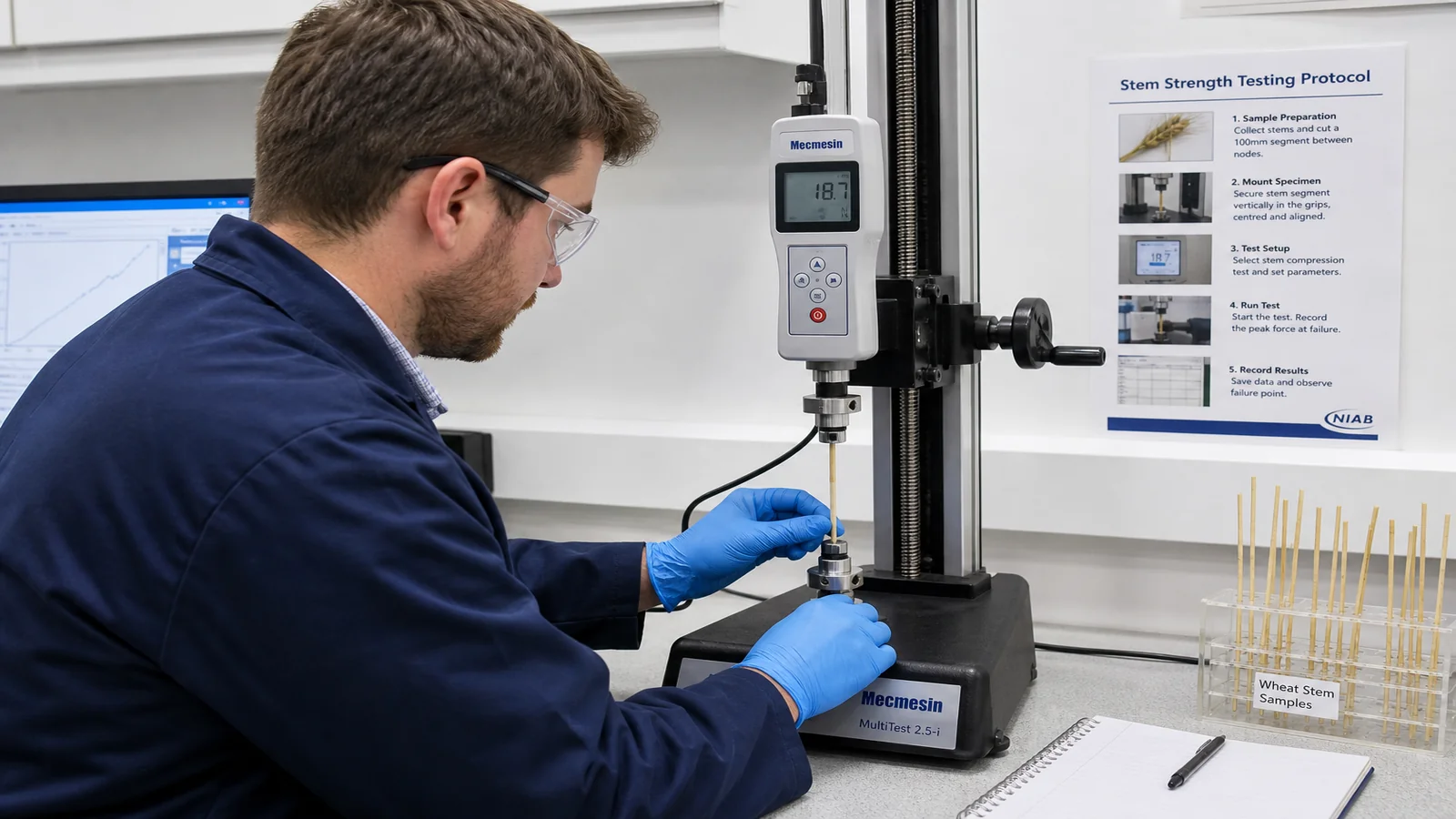
How to use plant stem strength tester protocol: UK practical operate checklist
How to use plant stem strength tester protocol is a bench question, not a catalogue browse: “What do I actually do at the bench between harvest bags and the spreadsheet?” This checklist is for UK lab and plot technicians running a 50N-class cereal stem meter such as the Hongwei HW-JG2B. It is a practical sequence you can repeat between stations. It is not a claim that any single manufacturer page satisfies an AHDB or RL trial protocol—you still map steps to your trial SOP.
Who this operate checklist serves
Use it when you train new students on wheat or rice internodes, when a CRO swaps operators mid-season, or when a breeding programme adds stem force beside visual lodging scores. Skip it if you are trying to force maize stalks through a 50N cereal instrument—that is a crop-class mistake, not an operator skill gap.
Pre-checks: crop class and misuse refusals
- Confirm samples are wheat, rice or similar cereal culms within the 50N band—not maize/sorghum/sugarcane class stalks.
- Confirm fixtures match the mode you wrote in the notebook: bending, compression or puncture-style work.
- Confirm the test stand is square, the ruler span matches yesterday’s setting, and the gauge shows a stable zero before loading.
- Refuse to “make it fit” on out-of-range stems; note the refusal in the lab book instead of bending the crop class.
Step sequence operators can repeat
- Label the plot, genotype, growth stage and internode position on the sample tag before cutting.
- Prepare stem segments to your written length; keep knife and hydration handling consistent across the batch.
- Mount the stem on the stand supports at the chosen span; avoid finger pressure on the measured internode.
- Zero the gauge with fixtures engaged but before stem contact, if your SOP requires it.
- Load smoothly at a controlled rate; do not jerk the crosshead because you are rushing the queue.
- Record peak force (or hold value), mode, span, operator initials and timestamp in the LIMS or sheet.
- Reset peak hold, remove debris, and wipe fixtures before the next sample.
The 50N test stand guide explains why alignment beats hand-held improvisation for repeatability.
Consistency traps without inventing standards
Most argument in stem datasets comes from operator variation, not from the fourth decimal on the display. Watch span length drift, internode choice creeping up the culm, samples drying on the bench, and different loading speeds between morning and afternoon crews. Write those choices in the method section; do not pretend a factory operate sheet replaces your trial design.
For bending-specific vocabulary, cross-check the stem bending force tester guide on this site.
When readings look wrong
If peaks jump wildly, stop and check mechanical zero, loose stand bolts, cracked stems from rough cutting, or a span that does not match prior weeks. If every reading pegs high instantly, you may be on the wrong crop class or fixture. If readings are flat low, confirm you are loading the intended internode, not a leaf sheath. Escalate to the PI before you retcon last month’s data.
If the lab still needs a UK-stocked HW-JG2B
When your checklist is written and you still need the 50N wheat–rice Hongwei kit sold here, review the HW-JG2B detail page for current price and specification.
Is this an AHDB-approved protocol?
No. It is a practical operate checklist. Map it to your own approved SOP.
Can I skip the test stand?
You can, but alignment error usually costs you more time in statistics later.
Does peak hold replace replication?
No. Replicate stems and plots per your experimental design.