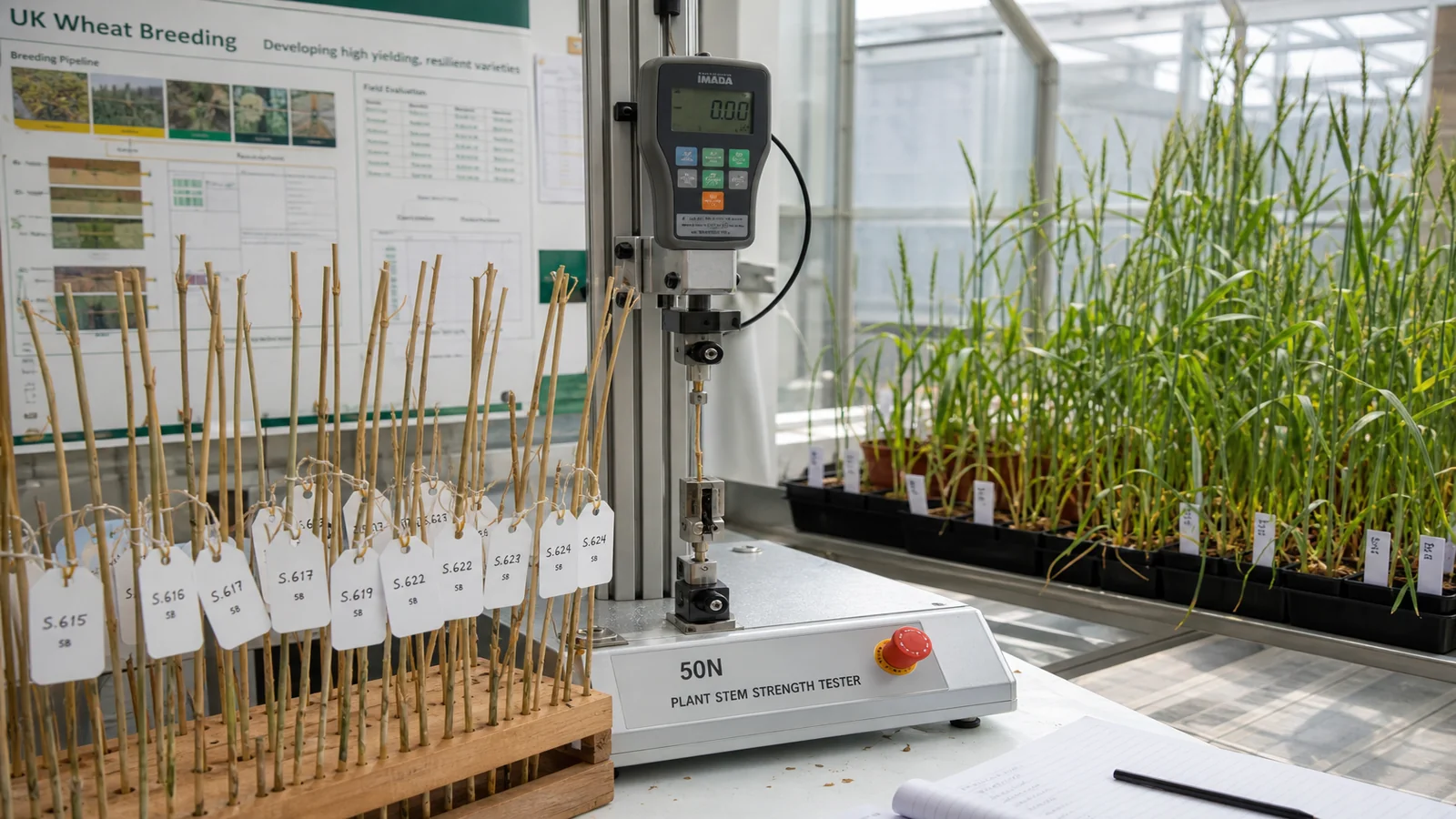
Wheat stem strength phenotyping meter breeding UK: use in selection programmes
Wheat stem strength phenotyping meter breeding UK is a workflow question. Winter wheat lines still get visual lodging scores on RL and breeder trials, but selection teams also want objective stem force to separate lines that look similar in the field. A dedicated 50N-class meter is one bench tool for that trait—alongside height, disease and yield data—not a replacement for the breeder’s eye or for weather risk models.
UK breeding context for stem force traits
Programmes at NIAB, KWS, university hubs and Harper Adams-style networks often run parallel glasshouse and plot screens. Stem strength enters when lodging resistance is a breeding target but hand flex tests are too subjective to rank hundreds of lines. The instrument does not tell you which line to release; it gives mechanical numbers you can merge with other traits in the selection index.
Where a 50N phenotyping meter fits
The Hongwei HW-JG2B on this site is specified for wheat and rice stem measurement at 50N / 0.01N with test stand and ruler option—appropriate for delicate-to-moderate cereal culms in phenotyping bays. Use it where:
- You already cut standard internode segments post-anthesis or at the growth stage your protocol fixes.
- You need repeatable bending or compression peaks across lines in the same nursery batch.
- You want a named UK SKU at £1051.00 inc. VAT rather than an unnamed import gauge.
The existing wheat stem strength tester buyer guide covers instrument choice language without duplicating this breeding schedule.
Sampling and timing practicalities
Write the calendar in your trial protocol, not in a product blog. Typical discipline includes tagging tillers by plot, cutting at a fixed internode relative to the peduncle, hydrating or conditioning segments consistently, and measuring within a defined window so stems do not dry unevenly. Run a pilot week before the main diversity panel—operator training beats heroic weekend catch-up.
SOP notes that stay claim-safe
Keep the method section boring and auditable: span length, loading mode, crosshead speed band, number of stems per plot, and exclusion rules for damaged plants. Do not claim AHDB protocol compliance because you bought a meter. Do not claim plant growth regulator efficacy from force readings alone. Do not publish lodging forecasts from bench peaks.
Bending vocabulary for methods drafts lives in the stem bending force tester guide.
Multi-site logistics
If Cambridge measures Monday and Aberystwyth measures Thursday, ship a written SOP plus fixture photos, not just the gauge. Duplicate ruler marks on both stands, log serial numbers, and run a shared reference stem batch when teams reunite. Phenotyping quality is a logistics problem as often as it is an instrument problem.
Review the HW-JG2B detail page if it fits
When your breeding programme wants the 50N wheat–rice Hongwei kit stocked in the UK, read the current listing on the HW-JG2B detail page.
Does stem force replace visual lodging scores?
No. It complements them with objective mechanical data.
Can this meter pick the winning cross?
No. It feeds one trait into a wider selection index.
Is 50N always enough for every wheat experiment?
It fits the cereal culm class described for this SKU. Extreme stems or wrong crops need a different specification conversation.